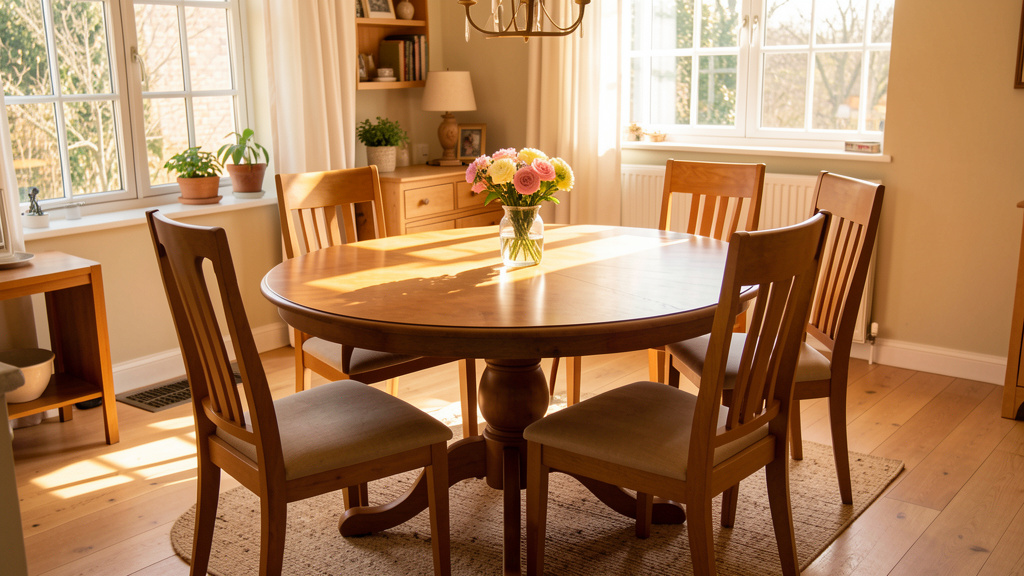
Stop guessing. Start designing. Discover practical spatial strategies, material insights, and human-centered considerations that transform your dining area from an afterthought into the warm, functional heart of daily life.
Selecting a dining table represents one of the most meaningful furniture decisions you’ll make. This single piece anchors daily rituals—from morning coffee and homework sessions to holiday feasts and heartfelt conversations—and its influence extends far beyond aesthetics. Yet many homeowners experience frustration when a beautiful table arrives only to dominate the room, create traffic bottlenecks, show wear unexpectedly, or feel perpetually cramped during gatherings. This guide offers a clear, compassionate methodology grounded in spatial principles, material behavior, and real-world living patterns. We’ll walk you through measurable clearance guidelines, room-shape diagnostics, material considerations for your actual lifestyle, and adaptable strategies for evolving needs. By the end, you’ll feel confident choosing a table that supports your life today while honoring your journey tomorrow.
Introduction: Why Your Dining Table Decision Holds Quiet Significance
The dining table occupies a unique space within the home. Unlike furniture serving primarily individual comfort, the table is inherently communal—a stage for connection, conversation, and shared moments. Many households observe that having a dedicated space for meals encourages more mindful eating and meaningful interaction, especially when separated from screens or multitasking zones. Yet this centrality also means a poorly aligned table creates persistent friction: chairs that snag on walls, surfaces requiring constant vigilance, or dimensions that isolate rather than include.
Interior design wisdom emphasizes that furniture selection begins with spatial awareness and human patterns, not visual appeal alone. A table chosen solely for style often becomes a source of daily compromise. Conversely, a table selected through intentional alignment of room geometry, household rhythms, and material suitability becomes quietly supportive—enhancing life without demanding attention. This guide synthesizes spatial planning principles, material behavior insights, ergonomic considerations, and lived-experience patterns into an accessible framework. We move beyond subjective “what looks nice” advice toward objective, measurable criteria you can apply with confidence. Whether furnishing a compact city apartment, a growing family’s open-concept home, or a formal dining room used for special occasions, this approach helps you choose with clarity and care.
The Harmony Framework: Three Interlocking Pillars for Confident Selection
Forget fragmented checklists. Lasting satisfaction emerges from the intentional alignment of three foundational pillars: Spatial Harmony (how the table relates to your physical environment), Lifestyle Harmony (how it serves your daily rhythms and people), and Temporal Harmony (how it adapts to your evolving journey). These pillars interact dynamically. A magnificent reclaimed wood table (Temporal Harmony) becomes impractical if it blocks a doorway (Spatial Harmony). An extendable table perfect for holiday gatherings (Lifestyle Harmony) may feel cavernous in a small room used nightly by two (Spatial Harmony). The Harmony Framework provides a sequential, compassionate path to navigate these interdependencies.
The Guiding Insight: A truly harmonious dining table feels inevitable—not because it follows a trend, but because its presence supports your space, your story, and your tomorrow with quiet grace.
Pillar 1: Spatial Harmony – Designing for Flow and Comfort
Spatial Harmony begins with understanding your room as a living system of movement, light, and proportion. This pillar transforms uncertainty into clarity through gentle measurement and observation.
Step 1: Map Your Room’s True Dimensions (Beyond Wall-to-Wall)
Gather a tape measure, paper, and pencil. Create a simple sketch noting:
– Exact room dimensions (length × width × ceiling height)
– All fixed elements: Door swings (trace the arc!), window sills, radiators, built-in cabinets, fireplace hearths, light switch locations
– Traffic pathways: Identify primary routes (e.g., kitchen to living area). Measure their usable width.
– Architectural features: Bay windows, columns, sloped ceilings, or alcoves creating non-rectangular spaces
Why this step matters: A door swinging into the planned table location creates daily friction. Ignoring a radiator means chairs cannot tuck properly. These overlooked details commonly lead to post-purchase frustration.
Common pitfall to avoid: Measuring only open floor space while neglecting how doors, cabinets, or appliances project into the area when in use. Always measure with doors fully open.
Gentle suggestion: Use painter’s tape on the floor to outline potential table footprints before shopping. Live with the tape outline for 24 hours. Walk through the space. Simulate pulling out chairs. Does movement feel natural? Does the outline anchor the room or overwhelm it?
Step 2: Establish Comfortable Clearance Zones (The 36-Inch Guideline)
For ease of movement and seated comfort, maintain generous space around the table perimeter:
– Minimum 36 inches (91 cm) between table edge and any wall, cabinet, or fixed obstacle. This allows chairs to be pulled out comfortably and people to pass behind seated guests.
– Ideal 42–48 inches (107–122 cm) for rooms used frequently for entertaining or with larger chairs/benches. This prevents the “squeeze-past” feeling during meals.
– Critical consideration: If a wall has a door swinging into the dining area, add the door’s swing radius (typically 18–24 inches) to the clearance requirement on that side.
Practical illustration: In a 10′ × 12′ (3m × 3.6m) dining nook:
– Max table width = Room width (120″) minus 2× clearance (72″) = 48″ max width
– Max table length = Room length (144″) minus 2× clearance (72″) = 72″ max length
This confirms a standard 72″ × 42″ rectangular table fits only if clearance is precisely 36″ on all sides—and only if no doors swing inward. If a door swings in, the max length reduces to approximately 60″.
Helpful contrast: Placing a 96″ long table in this room leaves only 24″ of clearance on long sides. Chairs cannot be pulled out fully without blocking pathways, creating friction during meals.
Adaptable approach: In tighter spaces, prioritize clearance on active sides (where people walk) and accept slightly less (30″) on a quiet wall side—but avoid going below 30″ where possible.
Step 3: Match Table Shape to Room Geometry (The Shape Diagnostic)
Shape serves function first. Use this diagnostic to align form with your space:
| Room Shape | Recommended Table Shape | Why It Works | Shape to Approach Cautiously | Why It May Challenge Flow |
|---|---|---|---|---|
| Square Room | Round or Square | Centers the space visually; allows equal access; maximizes perimeter flow | Long Rectangle | Creates unused corner zones; disrupts room symmetry |
| Rectangular Room | Rectangle or Oval | Echoes room lines; efficient use of space; clear traffic lanes | Round (if room narrow) | May feel visually unanchored; wastes corner space |
| Narrow Room | Narrow Rectangle or Bench-Style | Fits proportionally; preserves side clearance; benches save width | Square or Large Round | Blocks pathway; intensifies confined feeling |
| Open-Concept | Rectangle, Oval, or Large Round | Defines the dining zone without walls; softens transitions | Small Square | Fails to anchor the area; feels insignificant |
| Alcove/Nook | Custom Shape (e.g., cut-corner) | Maximizes every inch; fits precisely into irregular space | Standard Rectangle | Wastes precious nook space; may not fit |
| Very Small (<80 sq ft) | Drop-Leaf, Wall-Mounted, or Round | Folds away when unused; round eliminates bump-prone corners | Fixed Large Table | Consumes entire space; limits room functionality |
Deeper perspective: The language of shape
– Rectangular tables naturally suggest seating order. Ideal for households valuing defined roles or formal gatherings.
– Round tables eliminate hierarchy—everyone faces each other equally. Fosters inclusive conversation; excellent for discussion-focused homes or compact spaces where corners impede flow.
– Oval tables blend elongated capacity with softened edges. Offers flexible seating without sharp corners; ideal for rooms needing gentle definition.
– Square tables feel intimate and balanced for 2–4 people but become impractical beyond four (seating at corners reduces comfort). Best for breakfast nooks or compact apartments.
Adapting to complexity: For L-shaped rooms, position the table in the larger section, ensuring clearance on accessible sides. Use the shorter leg for a console or greenery. In irregular spaces, a round table often integrates most gracefully without emphasizing awkward angles.
Step 4: Determine Seating Capacity Realistically (Not Optimistically)
Manufacturer claims like “seats 8” reflect ideal conditions. Real-world comfort depends on chair width and desired elbow room. Use this practical guide:
Effective Table Length (inches) ÷ 24 = Comfortable Seats
(24″ per person allows comfortable elbow room and plate space; 20″ is workable for occasional use)
| Table Length | Comfortable Seats (24″/person) | Occasional Seats (20″/person) | Practical Notes |
|---|---|---|---|
| 60″ (5 ft) | 2 | 3 | Ideal for two; tight for three |
| 72″ (6 ft) | 3 | 4 | Standard comfort for four |
| 84″ (7 ft) | 3–4 | 5 | Cozy for five; spacious for four |
| 96″ (8 ft) | 4 | 6 | True comfort for six |
| 108″ (9 ft) | 4–5 | 7 | Spacious for six; comfortable for seven |
| 120″ (10 ft) | 5 | 8 | Generous comfort for eight |
Important nuance: Armchairs require 26–28″ per seat. Benches along one side optimize space—calculate bench length ÷ 18″ per person (benches allow slightly tighter seating).
Real-life scenario: Needing to seat six regularly? A 96″ table provides genuine comfort. Choosing an 84″ table “to save space” may lead to constant elbow contact—a subtle daily friction. If space only allows 84″, consider a bench on one side: 84″ ÷ 18″ ≈ 4.7 people on bench + 2 chairs on ends = six seats comfortably.
Forward-looking tip: If anticipating household growth, adding 12–24″ of length beyond current needs offers breathing room. An extendable table elegantly addresses this need.
Pillar 2: Lifestyle Harmony – Aligning Material and Function with Daily Reality
A table that supports your life—not just your decor—is chosen through honest reflection. This pillar moves beyond “I like wood” to “Will this material welcome my mornings, meals, and moments?”
Step 1: Conduct a Gentle Lifestyle Reflection
Take a quiet moment to answer without judgment:
– Household rhythm: How many typically gather here? Ages of children? Pets? Frequency of guests?
– Daily use: Daily meals? Homework hub? Craft station? Work-from-home surface? Game nights?
– Care preferences: How quickly are spills wiped? Are placemats used consistently? Tolerance for natural wear?
– Sensory considerations: Sensitivity to chair-scraping sounds? Preference for warm textures? Concern about chemical finishes?
– Budget perspective: Total investment including chairs? Prioritizing longevity? Willingness to maintain?
Why this reflection matters: A high-gloss table in a home with active children and art projects may create unnecessary anxiety. A delicate glass table in a household hosting weekly gatherings might invite constant vigilance. Matching material to actual behavior prevents future friction.
Common tendency to notice: Choosing based on an aspirational lifestyle (“We’ll host elegant dinners!”) rather than current patterns (“We often eat while helping with homework”). Honesty here is kindness to your future self.
Helpful framing: Consider scoring each factor 1–5 (1=low impact, 5=critical). Higher scores in “spills,” “scratches,” or “heavy use” suggest durable, forgiving materials. Higher scores in “aesthetics” or “formality” allow more delicate choices.
Step 2: Material Considerations – Understanding Behavior and Care
Look beyond the showroom sample. Understand how materials interact with real life:
Solid Wood (Oak, Maple, Walnut, Cherry, Teak)
Nature and behavior: Made from harvested timber. Naturally responsive to humidity—expands slightly in moist air, contracts in dry conditions. Hardness varies: Maple > Oak > Walnut > Cherry. Teak offers exceptional outdoor resilience.
Living with it:
– With active households: Minor scratches often blend into grain character; deeper marks can be professionally refinished. Lighter woods show scratches more readily.
– Care rhythm: Periodic re-oiling or waxing (every 6–18 months depending on use). Use coasters for moisture protection.
– Aesthetic range: Rustic to refined. Each piece carries unique grain patterns.
– Investment perspective: Higher initial investment ($1,200–$5,000+), but decades-long potential with proper care. Refinishing extends life significantly.
– Gentle guidance: Avoid placement near radiators, AC vents, or direct sun. Use felt pads under decor. In regions with distinct seasons, maintaining indoor humidity between 35–55% supports stability.
Seasonal note: During dry winter months, wood may contract slightly; humid summer months may cause subtle expansion. This natural movement is normal in solid wood and managed through stable indoor humidity.
Engineered Wood (Veneer over Plywood/MDF)
Nature and behavior: Thin layer of real wood bonded to stable composite core. Resists warping better than solid wood in humidity fluctuations.
Living with it:
– With active households: Good durability with quality finishes. Avoid sharp impacts that could chip the veneer surface.
– Care rhythm: Wipe spills promptly. Surface cannot be deeply sanded—damage is typically permanent.
– Aesthetic range: Mimics solid wood beautifully; consistent grain patterns.
– Investment perspective: Mid-range ($500–$2,000). Strong value when protected from heavy abuse.
– Gentle guidance: Verify veneer thickness—thicker veneers (1/16″ or more) offer greater resilience. Cross-banded veneer (layers at angles) enhances stability. Avoid MDF cores in consistently humid environments.
Glass (Tempered)
Nature and behavior: Annealed glass heat-treated for safety (breaks into small pebbles, not sharp shards). Highly scratch-resistant surface but shows fingerprints, crumbs, and water spots readily.
Living with it:
– With active households: Requires frequent wiping. Chair movement creates audible contact.
– Care rhythm: Daily cleaning with glass cleaner and microfiber cloth.
– Aesthetic range: Modern, airy; enhances perception of space in smaller rooms.
– Investment perspective: $400–$1,800. Tempered glass is essential for safety.
– Gentle guidance: Tinted (bronze, gray) or frosted glass minimizes visible smudges. Pair with upholstered chairs to soften sound. Always confirm tempered certification.
Metal (Steel, Iron, Aluminum)
Nature and behavior: Cast, welded, or powder-coated frames; often paired with wood, glass, or stone tops. Extremely impact-resistant.
Living with it:
– With active households: Excellent durability. Chair legs may scratch metal bases (use felt pads).
– Care rhythm: Wipe with damp cloth. Touch up powder coat chips to prevent rust.
– Aesthetic range: Industrial, modern, farmhouse (with wood top).
– Investment perspective: $600–$3,000. Substantial weight—verify floor suitability.
– Gentle guidance: Metal conducts temperature. In cooler climates, pairing with a wood or stone top adds warmth under hands.
Stone (Marble, Granite, Quartz)
Nature and behavior:
– Marble: Porous natural stone. Vulnerable to staining from wine, oil, citrus; scratches relatively easily. Requires sealing.
– Granite: Extremely hard natural stone. Heat and stain-resistant. Very heavy.
– Quartz: Engineered composite. Non-porous, stain-resistant, consistent patterns. Less heat-tolerant than granite.
Living with it:
– With active households: Granite and quartz excel in high-traffic homes. Marble requires vigilant care—best reserved for low-traffic or formal settings.
– Care rhythm: Granite/quartz: wipe spills. Marble: immediate wiping + periodic sealing.
– Aesthetic range: Luxe, timeless, substantial presence.
– Investment perspective: $1,500–$4,000+. Professional installation recommended due to weight.
– Gentle guidance: Always use placemats. Pair with cushioned seating for comfort. Avoid acidic spills on marble (etching is permanent).
Laminate & High-Pressure Plastic (HPL)
Nature and behavior: Decorative layer fused under heat/pressure to composite core. Highly resistant to scratches, stains, and heat.
Living with it:
– With active households: Outstanding durability. Wipe-clean surface ideal for crafts, homework, or messy eaters.
– Care rhythm: Virtually maintenance-free. Avoid direct cutting on surface.
– Aesthetic range: Modern patterns; convincingly mimics wood, stone, or solid colors.
– Investment perspective: $300–$1,200. Exceptional value for busy households.
– Gentle guidance: Look for “post-formed” edges (seamless curve) for enhanced chip resistance. Quality laminates resist peeling for many years.
Step 3: Functional Features – Solving Everyday Needs
Material choice intersects with practical requirements:
– Extendable Tables: Essential for variable households. Types:
– Butterfly leaf: Leaf stores under tabletop; smooth operation. Ideal for frequent use.
– Removable leaf: Requires storage space; very sturdy when inserted.
– Self-storing leaf: Leaf slides out from center; modern convenience.
Helpful tip: Test the mechanism in person if possible. Does it operate smoothly? Does it feel stable when extended? Prioritize secure locks.
– Pedestal vs. Four-Leg Bases:
– Pedestal: Maximizes legroom; ideal for round tables or tight spaces. Verify base stability.
– Four-leg: Traditional stability; better weight distribution for heavy tops. May limit legroom if legs are wide-set.
– Height Considerations:
– Standard (28–30″): Pairs with most dining chairs.
– Counter Height (34–36″): Creates casual vibe; ideal for kitchen-adjacent dining. Ensure adequate knee clearance.
– Bar Height (40–42″): Best suited for small breakfast bars with tall stools.
– Edge Profiles: Rounded edges enhance safety for children and ease cleaning. Sharp edges offer contemporary style but require mindful placement.
Step 4: Chair-Table Synergy (A Often Overlooked Connection)
Your table choice influences chair compatibility:
– Seat Height: Chair seat should sit 10–12″ below table height. Standard table (30″) pairs with chair seat at 18–20″.
– Arm Clearance: Armchairs need 2–3″ of space between arm and table edge. Measure chair arms before finalizing table choice.
– Tuckability: Chair legs/arms must slide fully under the table when not in use.
– Style Dialogue: Chairs need not match perfectly. Mixing wood tones works when undertones harmonize (e.g., warm walnut table + warm oak chairs). Upholstered chairs soften hard table surfaces.
Practical reminder: When purchasing online, verify chair dimensions against table overhang and leg placement to avoid compatibility issues.
Pillar 3: Temporal Harmony – Designing for Evolution and Legacy
A harmonious table accommodates life’s natural shifts—new family members, relocated homes, evolving tastes—without demanding replacement. This pillar builds gentle resilience into your choice.
Step 1: Consider Longevity Through Three Lenses
- Physical Longevity: Will the material and construction withstand years of use? Solid wood with traditional joinery (mortise-and-tenon) > quality veneer > laminate > particleboard. Examine construction details.
- Style Longevity: Does the design lean heavily into a fleeting trend? Timeless shapes (clean-lined rectangle, classic trestle) and neutral materials (medium oak, walnut, black metal) adapt gracefully to changing decor.
- Functional Longevity: Can it grow with your needs? Extendable tables add flexibility. Tables with subtle storage gain utility over time. Modular designs allow reconfiguration.
Why this perspective matters: Thoughtful furniture choices reduce long-term waste and cost. Well-constructed tables often become cherished heirlooms, carrying stories across generations.
Helpful contrast: A trendy acrylic table may feel contemporary today but can appear dated quickly and is prone to scratching, limiting its long-term role.
Budget-conscious path: If resources are limited now, prioritize repairability. A solid wood table with minor wear can be refreshed later. A laminate table with a chipped edge typically cannot be repaired—replacement becomes necessary.
Step 2: Adaptive Strategies by Life Context
- Newlyweds / Empty Nesters: Prioritize intimacy and quality. A smaller round or square table (42–48″) in solid wood creates warmth. Consider lighter weight for easier repositioning if future moves are likely.
- Growing Families: Choose extendable tables (comfortable for 6, expands to 8–10). Opt for durable, wipeable surfaces (sealed oak, quartz, quality laminate). Rounded corners enhance safety.
- Frequent Entertainers: Prioritize smooth extension mechanisms and stable bases. Oval tables often seat larger groups more comfortably than rectangles. Consider chair storage solutions.
- Multi-Generational Homes: Explore height considerations or pairing standard chairs with one supportive armchair. Avoid glass tops if mobility aids are used nearby.
- Renters / Transitional Living: Focus on lightweight, modular, or foldable options. Metal-frame tables often disassemble easily. Document condition carefully for security deposits.
Climate consideration: In humid regions, engineered wood may offer greater stability than solid wood; in very dry climates, solid wood with humidity management can thrive for decades.
Step 3: Conscious Considerations (Honoring People and Planet)
Temporal Harmony extends to broader impact:
– Wood Sourcing: Look for FSC (Forest Stewardship Council) or PEFC certification, indicating responsibly managed forests. Reclaimed wood offers unique character with minimal new resource use.
– Finish Chemistry: Low-VOC or natural oil finishes (linseed, tung) support better indoor air quality versus solvent-heavy alternatives.
– Craftsmanship Ethics: Research brands committed to fair labor practices. Local makers reduce shipping emissions and strengthen community economies.
– End-of-Life Thoughtfulness: Can components be separated for recycling? Wood and metal frames have strong recyclability. Avoid composites with non-recyclable binders where possible.
Gentle practice: A well-cared-for solid wood table can become a family legacy. Consider documenting its story—where it came from, milestones celebrated around it—to deepen its meaning over time.
Step 4: The Relocation and Resale Perspective
Before finalizing:
– Future home fit: If planning to move within a few years, avoid oversized tables or styles too specific to your current architecture.
– Resale appeal: Neutral materials and classic shapes typically have broader appeal if you choose to sell later.
– Moving practicality: Tables with bolt-together legs (versus glued) are far easier to transport. Photograph assembly instructions.
– Protection during moves: Wrap components separately. Lift—never drag—the table. Use breathable moving blankets rather than plastic wrap (which can trap moisture).
Navigating Common Scenarios: Practical Paths for Real Homes
Even with thoughtful planning, constraints arise. Here are compassionate, adaptable solutions for frequent situations.
Scenario 1: “My Space Feels Too Compact for a Traditional Table”
Reality: Many homes feature intimate dining areas. Forcing a standard table creates tension.
Adaptable paths:
– Wall-mounted drop-leaf table: Folds flat against wall when unused. Ideal for breakfast nooks. Confirm wall studs can support weight (use appropriate anchors).
– Nesting tables: Two small tables that tuck together. Use separately for projects, combine for meals.
– Banquette seating: Built-in bench saves 12–18″ of clearance space. Pair with a narrow rectangular table. Custom banquettes maximize space but require carpentry.
– Round table advantage: A 36″ round table seats 2–4 comfortably with no corners to navigate. Often feels more spacious in tight quarters.
Gentle reminder: In rooms under 80 sq ft, prioritize daily usability over idealized form. A well-chosen small table used consistently holds more value than a large table stored away.
Scenario 2: “I Occasionally Host Larger Groups, But My Space Comfortably Fits Only Six”
Reality: Overcrowding strains both furniture and relationships.
Adaptable paths:
– Strategic bench seating: Replace two chairs with a bench on one long side. Gains 1–2 seats without increasing table length. Benches tuck fully under the table.
– Smart extendable table: Choose one where the leaf stores within the table (butterfly or self-storing). No hunting for leaf in storage.
– Two intimate tables: Place two 42″ round tables side-by-side. Creates cozy conversation groups; flexible for varying guest counts.
– Complementary surfaces: For rare large gatherings, use a separate folding table for buffet items elsewhere. Keep the main table at comfortable capacity.
Kind consideration: Prioritizing comfort for regular use honors daily well-being. Special occasions can be accommodated creatively without compromising everyday peace.
Scenario 3: “I Admire Marble’s Beauty, But My Home Has Young Children”
Reality: Marble’s elegance requires consistent care that may not align with current household rhythms.
Adaptable paths:
– Quartz alternative: Engineered quartz offers marble-like veining with superior stain and scratch resistance. Non-porous surface requires no sealing.
– Porcelain slab: Modern technology creates durable, lightweight slabs with stone aesthetics and excellent resilience.
– Mindful marble use: If committed to marble: consistently use placemats and coasters. Keep a pH-neutral cleaner nearby. Some owners embrace subtle etching as part of the table’s evolving story.
– Contextual placement: Reserve marble for a formal dining room used primarily for adult gatherings; choose durable quartz or sealed wood for the everyday kitchen table.
Compassionate perspective: Choosing quartz isn’t compromise—it’s aligning material with current life rhythms. Both choices honor your values.
Scenario 4: “My Open-Concept Layout Lacks a Defined Dining Zone”
Reality: Tables can feel visually disconnected or disrupt flow.
Adaptable paths:
– Lighting anchor: Hang a pendant light centered over the intended table location. This visually defines the zone.
– Rug definition: Place a rug large enough that all chair legs remain on it when pulled out (add 24″ to table dimensions).
– Furniture boundaries: Position the table so its edge aligns with a sofa back or kitchen island edge, creating gentle separation.
– Shape strategy: A large round or oval table softens transitions between zones more gracefully than sharp-cornered rectangles.
Design insight: In open plans, the dining area should feel connected yet distinct. Table placement should encourage natural traffic flow around it, not through it.
Scenario 5: “My Budget Is Limited, But I Want a Table That Lasts”
Reality: Short-term savings can lead to greater long-term cost and waste.
Adaptable paths:
– Prioritize the foundation: Invest in a solid wood or heavy-gauge metal base. Tops can sometimes be refinished or replaced later.
– Secondhand treasures: Estate sales, community marketplaces, or antique stores often offer solid wood tables needing minor refreshment. Sanding and re-oiling can be deeply satisfying and economical.
– Thoughtful DIY: A sturdy pre-cut wood slab paired with quality hairpin legs creates a durable, personalized table. Seal edges thoroughly.
– Phased approach: Acquire a quality table first; collect chairs gradually. Mixing vintage and new chairs adds character and spreads investment.
Long-view perspective: A $400 table lasting five years costs $80/year. A $1,200 table lasting twenty-five years costs $48/year—and may be refinished to extend its life further. Quality often pays gentle dividends.
Beyond the Table: Cultivating a Welcoming Dining Experience
The table anchors the space, but surrounding elements shape the full experience. Integrate these thoughtfully.
Chair Selection: Where Comfort Meets Connection
- Seat depth: 16–18″ typically supports thighs comfortably. Too shallow = inadequate support; too deep = difficulty sitting back.
- Seat height: As noted, 10–12″ below table height. Test with your actual table if possible.
- Back support: Gentle lumbar contour prevents fatigue during longer meals.
- Upholstery considerations: Performance fabrics (Crypton, Sunbrella) resist stains and clean easily. Leather develops a warm patina. Wood seats offer durability—add cushions for extended comfort.
- Mixing chairs: Creates visual interest. Maintain cohesion through consistent seat height, harmonizing wood tones, or unified cushion fabric. Avoid jarring style contrasts.
Lighting: Shaping Atmosphere and Function
- Pendant height: Bottom of fixture hangs 30–36″ above table surface. Lower for intimate dinners; higher for standing clearance.
- Fixture scale: Should be approximately 12″ narrower than table width (e.g., 36″ fixture over 48″ table).
- Layered approach: Combine pendant (task lighting for food) with ambient (dimmed overhead, wall sconces) and accent (candles, buffet lamp).
- Light quality: Warm white (2700K–3000K) enhances food colors and feels inviting. Avoid cool white (4000K+), which can feel clinical. Dimmable LEDs offer versatile mood control.
Quiet insight: Lighting subtly influences dining duration and mood. Warm, focused light encourages lingering conversation; bright overhead light may hasten meals.
Rugs: Defining Space and Softening Sound
- Size guideline: Rug extends 24″ beyond table on all sides. Ensures chairs remain on rug when pulled out.
- Material choice: Low-pile wool or polypropylene. Avoid high-pile rugs (difficult for chair movement) or delicate silks (stain vulnerability).
- Pattern wisdom: Medium-scale patterns disguise crumbs and wear better than solids. Avoid patterns that visually clash with table or chairs.
- Essential addition: Use a non-slip rug pad to prevent sliding and reduce noise.
Styling: Intention Over Accumulation
- Centerpieces: Keep low (under 12″) so guests maintain eye contact. Use trays to corral items.
- Daily essentials: Store salt/pepper, napkins in a small basket for easy access.
- Seasonal refresh: Rotate textiles (runners, placemats) to welcome changing seasons without significant cost.
- Breathing room: Leave approximately 30% of table surface clear. A cluttered table feels chaotic; open space feels calm.
Simple practice: Before finalizing styling, sit in each chair position. Can you see across the table comfortably? Adjust items that obstruct view or movement.
Your Questions, Answered
Q: How much space should I leave between the dining table and a nearby kitchen island or counter?
A: Aim for a minimum of 42 inches (107 cm) between the table edge and any counter or island edge. This allows one person to access cabinets or the counter while another is seated. In constrained layouts, 36 inches is the practical minimum, though it may feel tight during simultaneous meal prep and dining. Always measure with cabinet doors fully open.
Q: Is solid wood always the superior choice compared to engineered wood?
A: Not universally. Solid wood offers repairability and develops character over time but responds to humidity changes and requires periodic care. High-quality engineered wood (thick veneer over plywood core) provides excellent stability in variable climates, resists warping, and delivers strong durability at a lower initial investment. For homes with consistent humidity control and willingness to maintain, solid wood is a beautiful choice. For humid environments, rental situations, or budget-conscious buyers prioritizing stability, quality engineered wood is a thoughtful, responsible option.
Q: Can I use an outdoor-rated table indoors?
A: Absolutely—and it can be an excellent strategy for high-traffic homes. Tables crafted from marine-grade polymer, powder-coated aluminum, or sustainably harvested teak (with an indoor-appropriate finish) offer exceptional resistance to scratches, stains, and moisture. They wipe clean effortlessly and withstand daily use beautifully. Ensure the aesthetic complements your interior style—many contemporary outdoor collections feature clean lines suitable for indoor living. Avoid tables with drainage holes in the surface.
Q: How can I help prevent water marks on my wooden table?
A: Prevention is most effective: consistently use coasters and placemats. For existing white marks (moisture trapped under finish): gently rub with a soft cloth dampened with equal parts baking soda and water. For deeper marks, a paste of non-gel toothpaste and baking soda may help. Always test in an inconspicuous area first. For valuable or antique pieces, consult a professional restorer. Regular application of appropriate furniture wax creates a protective barrier.
Q: What table material offers the greatest resilience for homes with young children and pets?
A: Prioritize surfaces that are non-porous, scratch-resistant, and easy to clean. Top considerations:
1. Quartz composite: Stain-proof, heat-resistant, seamless surface.
2. High-pressure laminate (HPL) with post-formed edges: Highly resistant to scratches, spills, and impacts.
3. Solid surface materials (e.g., Corian): Non-porous; minor scratches can be sanded out.
4. Sealed solid oak or maple: Scratches often blend into grain; entire surface can be refinished if needed.
Avoid glass (shows every smudge), marble (stains readily), and delicate veneers. Rounded edges add safety. Pair with performance-fabric chair cushions for easy cleaning.
Q: What details indicate thoughtful table construction?
A: Look closely at these elements:
– Leg attachment: Legs secured with bolts into a solid apron (frame beneath tabletop) indicate strength; legs screwed directly into the tabletop alone suggest less durability.
– Apron joinery: Mortise-and-tenon or dovetail joints reflect craftsmanship; numerous staples or thin glue blocks may signal lower resilience.
– Tabletop stability: Press firmly on corners. Minimal flex suggests a sturdy core. For wood tables, breadboard ends (cross pieces on ends) allow natural wood movement without cracking.
– Finish quality: Surface should feel smooth, not rough or sticky. Check edges for consistent coverage—thin spots are prone to chipping.
When shopping online, seek descriptions mentioning “kiln-dried wood,” “solid hardwood apron,” or “powder-coated steel frame.”
Q: Is mixing wood tones between table and chairs acceptable?
A: Yes—when done with intention. The key is harmonizing undertones:
– Warm tones (yellow, red, orange hints): Cherry, walnut, mahogany, golden oak.
– Cool tones (gray, brown, green hints): Ash, maple, bleached oak, driftwood.
Mix woods within the same undertone family (e.g., warm walnut table with warm oak chairs). Avoid pairing distinctly warm and cool tones unless a unifying element exists (e.g., black metal accents on both pieces). A neutral rug or wall color can gently bridge tones. When uncertain, bring samples home to view together in your lighting.
Q: How often should I maintain a solid wood table with oil or wax?
A: Frequency depends on use and finish type:
– Oil finishes (linseed, tung): Every 6–12 months for frequently used tables. Test by sprinkling a few drops of water on an inconspicuous spot—if water beads, protection is sufficient; if it soaks in, reapply.
– Wax finishes: Every 12–18 months. Buff gently with a soft cloth between applications.
– Lacquer/polyurethane finishes: Generally require no reapplication unless damaged. Clean with mild soap and water; avoid oil-based polishes that can build residue.
Always follow the manufacturer’s specific care guidance. Over-application can create stickiness; under-application leaves wood vulnerable. Use products formulated for dining surfaces.
Q: What is the ideal seat height for a dining bench?
A: Bench seat height should be 1–2 inches lower than standard chair seats—typically 17–18 inches from floor to seat surface. This allows comfortable knee clearance under a standard 30-inch table. Ensure bench depth is at least 15 inches for adequate thigh support. For backless benches, position so users can rest gently against the table edge. Add cushions covered in durable, cleanable fabric for comfort and longevity.
Q: Can I change the appearance of a laminate table top?
A: Standard laminate cannot be sanded and stained like wood. However, consider these options:
1. Painting: Clean thoroughly, lightly sand with fine-grit paper, apply bonding primer, then use chalk paint or cabinet-grade enamel. Seal with clear polyurethane.
2. Peel-and-stick veneer: High-quality wood-look films adhere smoothly to clean, smooth laminate surfaces.
3. Top replacement: Some tables allow top replacement. Measure precisely and source a new top in your preferred material.
Test any method on a hidden area first. For tables of significant value, professional refinishing services offer the most durable results.
Q: How should I approach table shape selection for a uniquely shaped room?
A: For truly round rooms, a round table centered in the space creates harmonious symmetry and maximizes flow. The circular form echoes the architecture gracefully. In very large round rooms, a substantial round table (60″+ diameter) provides visual anchor. Avoid rectangular tables in circular rooms—they create awkward triangular zones and disrupt the room’s natural geometry. For octagonal or multi-sided rooms, a round table typically integrates most fluidly; a square table may align with walls but often feels less organic.
Q: What makes a dining table choice more environmentally thoughtful?
A: Consider these interconnected aspects:
– Material origin: FSC-certified solid wood, reclaimed wood, bamboo (rapidly renewable), or recycled metal.
– Finish composition: Low-VOC water-based stains, natural oils (linseed, beeswax), or milk paint.
– Production ethics: Local craftsmanship reduces transportation emissions. Brands with transparent supply chains and fair labor practices.
– Longevity focus: Timeless design and durable construction reduce replacement frequency.
– End-of-life potential: Wood and metal are recyclable or biodegradable; avoid composites with non-recyclable binders where possible.
Secondhand tables embody sustainability by extending an existing item’s life. When purchasing new, seek brands embracing circular economy principles (repair services, take-back programs).
Conclusion and Your Next Step
Choosing a dining table is more than a furniture decision—it is an act of designing for human connection. By applying the Harmony Framework—aligning Spatial Harmony (measured awareness of your environment), Lifestyle Harmony (honest reflection on daily rhythms), and Temporal Harmony (gentle consideration for evolving needs)—you transform selection from stress into serene confidence. Remember three anchors: honor clearance for effortless movement, match material to your actual life patterns, and choose construction that carries intention forward.
The 24-Hour Reflection
Before finalizing any choice:
1. Tape the exact dimensions of your selected table onto your floor.
2. Place chairs (or stools) around the outline at proper spacing.
3. Live with this footprint for 24 hours. Move through it during morning routines, evening meals, and simulated gatherings.
4. Reflect: Does movement feel natural? Do chairs tuck comfortably? Does the scale feel inviting, not imposing?
This simple, zero-cost step offers profound clarity and can prevent future spatial friction. Trust the tape outline as your guide.
The Deeper Perspective
Your dining table is more than an object. It is a quiet witness to life’s ordinary and extraordinary moments—a surface that holds first bites, final exams, laughter, tears, and quiet conversations. Choosing it with intention honors those moments. A harmonious table recedes into the background of daily life, supporting connection without demanding attention. It becomes a gentle testament to thoughtful living: a piece that fits not just your room, but your rhythm; not just your style, but your story. In a world of fleeting choices, selecting a table built for longevity is a quiet commitment to presence, quality, and the enduring power of gathering around a shared table.
Explore Our Complete Home Harmony Collection:
Measuring Your Space: The Room-by-Room Guide to Furniture Sizing | Chair Comfort Decoded: Ergonomics for Everyday Sitting | Sustainable Home Furnishings: A Practical Buyer’s Roadmap | Lighting Layers: Creating Ambiance in Every Room | The Art of the Tablescape: Simple Styling for Meaningful Meals | Floor Care by Material: Preserving Your Investment | Open Concept Living: Defining Zones Without Walls