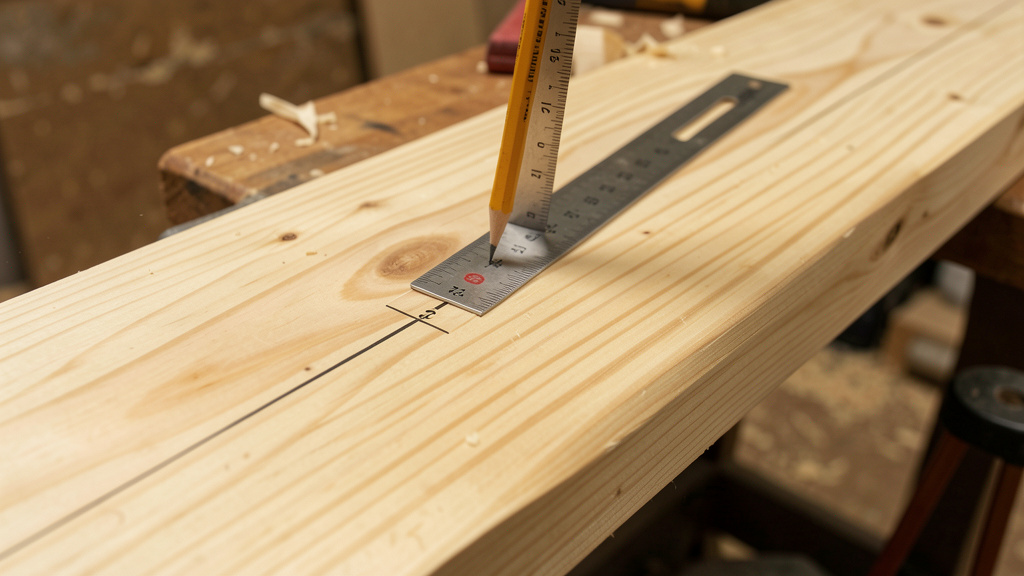
Unlock Consistent Precision with a Practical 5-Step System That Builds Confidence and Reduces Fitting Errors Across Every Project
Precision in measuring and marking forms the foundational layer upon which every successful project is built. This guide synthesizes time-tested craftsmanship principles with adaptable modern techniques to deliver a clear, actionable framework for achieving reliable accuracy across wood, metal, drywall, masonry, and composite materials. Whether installing cabinetry, fabricating brackets, or laying tile, these methods transform uncertainty into informed confidence—without promising perfection or relying on inaccessible tools.
Introduction
Step into any respected workshop—whether a traditional timber framing barn or a contemporary fabrication space—and you’ll notice a shared rhythm: measurements are taken deliberately, references are verified intentionally, and marks are placed with purpose. This isn’t ritual for its own sake. It reflects a deep understanding that every downstream action inherits the integrity of its upstream markings. A slightly misaligned reference point can compound through cutting, assembly, and finishing, revealing itself as gaps that resist closure, joints requiring forceful assembly, or structures lacking visual harmony. Grounded in widely recognized workshop practices and material behavior principles, this guide offers universally applicable precision strategies. True precision begins not with the tool in hand, but with mindful preparation, contextual awareness, and respect for the material’s inherent characteristics.
The Precision Pyramid: A Five-Step Framework for Reliable Accuracy
Imagine precision as a layered pyramid. Each tier supports the one above it. Neglect the foundation, and stability diminishes. This framework—refined through observation of diverse professional workflows across cabinetry, metal fabrication, and construction—provides a repeatable system where consistent accuracy becomes an achievable habit, not a matter of chance.
Step 1: Cultivate the Precision Mindset
Before touching a tool, prepare the mind. Precision begins internally.
Why This Step Is Essential
Measuring inconsistencies often trace back to cognitive factors: rushing, assumption, distraction, or unclear reference points. Workshop experience consistently shows that many errors originate not from faulty tools, but from overlooked details. Consider measuring a shelf against a warped scrap instead of the actual cabinet opening. The tape was accurate; the reference was not. Precision requires conscious presence.
The Three Mental Anchors
1. Reference Integrity: Always clarify: “What is my true zero point?” Is it the factory edge of the sheet? The finished wall surface? The centerline of a beam? Never assume. Physically verify and mark your primary reference before taking any measurement.
2. Directional Clarity: Measurements require shared understanding. “12 inches from the left” only works if “left” is defined. Establish simple project conventions: “All horizontal measurements start from the leftmost finished edge; all vertical measurements from the bottom datum.” Note this visibly near your workspace.
3. Tolerance Awareness: Perfection is rarely the goal—appropriateness is. Define your acceptable margin before beginning. Installing base cabinets? ±1/16 inch may be sufficient. Crafting a fine dovetail joint? ±1/64 inch becomes important. Knowing your tolerance prevents over-engineering simple tasks and under-preparing for critical ones.
Common Mindset Challenges
– The “Close Enough” Pattern: “It’s only slightly off—I’ll adjust later.” That minor gap may become visible after finishing. Later adjustments can alter dimensions, affecting adjacent components. Small compromises sometimes create larger complications.
– Measurement Recall: Taking a measurement but forgetting it before marking. Try saying it aloud twice (“Seventeen and three-eighths… seventeen and three-eighths”) while transferring. Engaging auditory memory adds reliability.
– Tool Overreliance: Assuming technology eliminates human factors. Laser measures require steady handling and correct mode selection; reflective surfaces can distort readings. Tools extend capability—they don’t replace thoughtful judgment.
Practical Exercise: The 60-Second Reset
Before any critical measurement:
1. Place both feet flat on the floor.
2. Take one slow breath.
3. Verbally state your reference point and target dimension.
4. Confirm lighting is adequate on the mark zone.
This brief ritual interrupts autopilot mode. Similar focused protocols are used in fields where precision matters deeply. Your project deserves that same mindful attention.
Step 2: Select and Master Your Tools
Tools extend intention. Choosing and using them thoughtfully bridges measurement and material.
The Core Toolkit: Function Over Flash
Tape Measures: Understanding the Hook
Not all tapes perform equally for precision work:
– Blade Quality: Look for clear fractional markings that resist wear. Blades with etched graduations often last longer.
– Hook Design: The slight play in the hook compensates for its own thickness during inside/outside measurements. Test yours: Measure a known 12-inch block. With hook tight against the block, reading should be 12″. Pulled taut from the edge, it should still read 12″. If inconsistent, the hook may need gentle adjustment.
– Reading Technique: Avoid parallax error. Position your eye directly perpendicular to the mark. For critical cuts, try the “burn an inch” method: Start measuring at the 1″ mark instead of the hook. Measure to 18″ for a 17″ cut. This bypasses potential hook variability.
– Material Considerations: Fiberglass blades resist kinking in cold environments; nylon-coated blades glide smoothly over rough lumber. For metalwork, a tape with a magnetic hook and durable markings offers practical advantages.
Squares: Verifying Geometry
– Try Square (Wood): Blade should be hardened steel. Check accuracy: Draw a line along the blade. Flip the square 180° and draw beside it. If lines diverge, accuracy is compromised. Some quality squares allow blade adjustment.
– Combination Square: A versatile choice. Ensure the head locks firmly. A sharp scriber tip creates clean layout lines. The integrated level vial aids quick slope checks.
– Framing Square: Ideal for large layouts. Check straightness of the tongue (short arm) and blade against a known straightedge. Store flat to maintain alignment.
– Precision Machinist Square: For fine metal or woodworking. Handle carefully—impact can affect calibration. Verification against a known reference surface is recommended periodically.
Marking Implements: Translating Measurement
– Pencils: A sharp 2H or 3H pencil creates fine, smudge-resistant lines on smooth wood. Softer leads (HB) show better on rough concrete. Keep a sharpener nearby.
– Marking Knives: Preferred for woodworking joinery. The knife scores wood fibers, creating a physical guide the saw follows precisely. Hold at 30–45° to the surface, angling with the grain direction.
– Scribes: Essential for metal layout. Carbide-tipped scribes cut cleanly through mill scale. Pair with layout dye (like Dykem) for high-contrast visibility on steel.
– Chalk Lines: For long straight lines on framing or drywall. Blue chalk suits interiors (less staining); red chalk works better outdoors. Snap twice: lightly to position, firmly for the final line.
– Lasers and Levels: Cross-line lasers project reference lines efficiently. Verify calibration periodically: Project a line on a wall 10 feet away, mark the center, rotate the laser 180°, and check alignment. Adjust per manufacturer guidance if needed.
Tool Care: Supporting Long-Term Accuracy
A dull pencil creates ambiguous lines. A gritty square pivot affects alignment. Simple maintenance preserves performance:
– Wipe tape blades with a dry cloth to remove debris affecting retraction.
– Lightly lubricate combination square pivots with sewing machine oil if stiff.
– Store squares hung vertically or in protective cases to prevent blade bending.
– Replace chalk line string when frayed—it won’t snap cleanly.
– For digital calipers, check battery status before critical use.
Adapting to Constraints
– Budget-Conscious Path: A reliable $12 tape measure (verify hook action), a $15 combination square (check accuracy before purchase), and a $3 marking knife. Technique matters more than price.
– Professional Path: Invest in tools known for durability and calibration retention (e.g., Starrett try squares, Milwaukee Deep Cut tapes) if heavy daily use is expected.
– Resourceful Alternative: No square available? Use the 3-4-5 triangle method. From a corner, measure 3 units along one edge, 4 units along the other. The diagonal between marks should be exactly 5 units for a 90° angle. Adjust until aligned.
Step 3: Execute Clear Marking Techniques
This is where preparation meets material. Technique adapts to substrate and context.
Woodworking: Working With the Material
- Knife-Line Advantage: For joinery (dovetails, mortise-and-tenon), a marking knife creates a precise groove guiding the saw. Pencil lines have width; knife lines offer near-zero width reference. Draw the knife toward you in one smooth motion.
- Hooking vs. Butting: For board width, hooking the tape is often sufficient. For critical joinery, “butt” the tape: Place the hook firmly against your reference edge (not hooked over it) to minimize play. Use a square to transfer perpendicularly.
- Marking Curves: Use a trammel point set or beam compass for arcs. For irregular shapes, a contour gauge captures profiles reliably.
- Working With Warped Stock: Avoid forcing warped material flat to mark. Instead, mark on the convex (high) side. Note the warp direction with a light pencil arrow. The cut will align when the piece is clamped during assembly.
Metal Fabrication: Clarity and Context
- Layout Dye Practice: Clean the metal surface. Apply layout dye. Let dry briefly. Scribed lines appear crisp and resist smudging during handling.
- Scribing Technique: Hold the scribe vertically. Drag firmly but smoothly. For drill centers, place a center punch precisely at the scribed intersection, then strike sharply.
- Thermal Consideration: Metals expand with heat. For large steel assemblies or precision fits in environments with significant temperature swings, be aware that dimensions can shift slightly. When critical, measure under stable conditions or allow for minor clearance. For most workshop projects, this effect is negligible—but awareness matters in specific contexts.
- Inside Measurements: Inside calipers transfer dimensions reliably. Compare caliper tips to a rule scale. Digital calipers simplify this but require functional batteries.
Drywall, Framing, and Construction: Scale and Practicality
- The Story Pole: For repetitive layouts (stair stringers, cabinet installations), create a story pole—a straight board marked with all key dimensions. Hold it against the work area to transfer measurements consistently. Reduces cumulative tape errors.
- Chalk Line Technique: Stretch the line taut. Lift the string 1–2 inches at midpoint and release sharply. For long lines (>15 ft), a helper holding the center minimizes sag. In wind, slightly dampening the chalk can improve adhesion.
- Leveling Large Surfaces: Use a 48″ or 72″ level for cabinets or countertops. Check front-to-back and side-to-side. For floors or foundations, a laser level on a stable tripod offers efficiency. Confirm the laser’s self-leveling range isn’t exceeded.
- Marking Rough Surfaces: On splintery framing lumber, use a carpenter’s pencil held flat against a square. The wide lead creates a visible line.
Material-Specific Considerations
- Plywood and Sheet Goods: Factory edges aren’t always square. Establish your own reference: Cut a small amount off one long edge using a straightedge guide. Use this new edge as your zero reference.
- Tile and Stone: Use a grease pencil or tile-specific marker. Verify marks won’t dissolve during setting. Score stone lightly with a carbide scriber before cutting.
- Plastics and Composites: Test markers on scrap first—some solvents smear. Light scribe marks may be preferable on materials prone to stress cracking.
- Curved Surfaces: For pipes or columns, a contour gauge captures the profile. Transfer the shape to your material for accurate cutting.
The Verification Pause
After making any critical mark, pause briefly. Ask:
1. Does this line align with my documented reference point?
2. Is the line clear, unambiguous, and visible under current lighting?
3. Have I accounted for saw kerf (the width of the cut)?
This moment of review helps catch discrepancies before proceeding.
Step 4: Verify Before You Proceed
Verification reflects thoroughness, not doubt. It’s a standard practice in reliable workflows.
The Dual-Method Cross-Check
Take critical measurements twice, using different approaches:
– Cabinet Width Example:
Method A: Measure the opening directly.
Method B: Measure from left stile to center, right stile to center, and sum.
Results should align within your defined tolerance.
– Diagonal Check for Frames: After assembling a rectangular frame, measure both diagonals. Equal measurements indicate squareness. More reliable than trusting a square alone on large assemblies.
– Center Finding: Measure total width, divide by two, mark. Then measure from the opposite edge to that mark—it should equal half the width. Recalculate if inconsistent.
The Mirror Technique for Symmetry
For symmetrical parts (table aprons, panels), mark one side carefully. Place a mirror along the intended centerline. The reflection should align with your marks. Any misalignment becomes immediately visible—no calculations needed.
Supportive Verification Tools
– Digital Angle Finders: Helpful for verifying compound angles, like crown molding installations. Always dry-fit test pieces first.
– Laser Distance Measures: Useful for room dimensions. Take multiple readings (floor, waist, ceiling) to account for minor variations. Average if needed.
– Smartphone Apps: Can serve as a secondary check (e.g., a level app), but verify the app’s accuracy against a trusted bubble level first. Never rely solely on apps for critical cuts.
When Verification Reveals a Discrepancy: A Calm Protocol
1. Pause. Stop work on that step.
2. Reconfirm your reference point. Has the workpiece shifted?
3. Re-measure using the alternate method.
4. Check tool condition. Is the tape hook functioning smoothly? Is the square accurate?
5. Review your notes. Was the original dimension recorded clearly?
This structured response turns uncertainty into a solvable step. Every experienced maker encounters this—it’s the response that builds skill.
Step 5: Adapt and Refine Continuously
Precision is a developing practice. Integrate reflection to grow steadily.
The Brief Project Review
After completing a project, spend five minutes noting:
– Where did measurements feel uncertain?
– Which mark was challenging to execute clearly?
– Did a verification step catch a potential issue? What was the cause?
– What small adjustment would improve the next project?
Jotting these insights in a dedicated notebook creates a personal knowledge base. Review it before starting new work.
Progressive Skill Development
– Starting Out: Focus on consistent pencil lines and square alignment. Practice marking ten identical cuts on scrap. Measure the results—variation highlights technique opportunities.
– Building Confidence: Introduce knife marking and story poles. Attempt a simple dovetail joint—accuracy provides clear feedback.
– Expanding Range: Work with mixed materials (wood-to-metal joints). Practice techniques for material movement or environmental factors. Explaining a technique to someone else often reveals deeper understanding.
Strategic “Good Enough”
Not every mark requires extreme precision. Installing fence posts? ±1/4 inch is generally acceptable. Building a small keepsake box? ±1/64 inch may matter more. Wisdom lies in matching effort to outcome. Ask: “Will this variation affect function, appearance, or structure?” Direct precision where it delivers the most value. This prevents fatigue on minor details while safeguarding critical elements.
The Fundamental Principle: Precision emerges from a continuous, adaptable cycle of preparation, execution, verification, and reflection—each step reinforcing reliability. Mastery grows from a thoughtful relationship between mind, method, and material.
Beyond the Basics: Adapting to Real-World Conditions
Projects rarely exist in ideal conditions. Here’s how core principles apply to common complex scenarios.
Working With Existing Structures: Embracing “As-Built” Reality
Older buildings settle. Walls may not be plumb. Floors slope. Measuring against theoretical perfection often leads to frustration. Instead, measure and adapt to what exists.
The Scribe Technique for Irregular Openings
Installing a shelf into a non-plumb bookcase?
1. Cut the shelf slightly oversized (about 1/4″ longer and deeper).
2. Place it loosely in position.
3. Hold a pencil perfectly vertical against the irregular wall surface.
4. Slide the pencil along the wall while keeping the shelf steady—the pencil traces the exact contour onto the shelf edge.
5. Cut along the scribed line. The shelf now fits the actual space.
Helpful Variation: Use a compass set to a small width (e.g., 1/8″). One leg follows the wall; the other scribes a consistent offset line on the shelf.
Measuring Out-of-Square Rooms
For baseboard in a room with non-90° corners:
1. Measure wall lengths at floor level.
2. Use a sliding T-bevel to capture each corner angle.
3. Transfer angles to your miter saw.
4. Dry-fit pieces before final attachment.
For crown molding (compound angles), a digital protractor helps measure spring angle and corner angle. Input into a dedicated calculator app for initial saw settings, then refine with test cuts. Always prioritize physical test fits over calculated numbers alone.
Accounting for Material Movement
Wood expands and contracts across the grain with humidity changes. A 12-inch wide oak board may shift up to 1/4 inch seasonally between very dry and humid conditions. When marking joinery:
– For breadboard ends: Mark elongated slots (not round holes) for fasteners to allow movement.
– For frame-and-panel doors: Include slight clearance (e.g., 1/16″ total) in the groove for panel expansion. Note this on your cutting diagram.
– In regions with significant humidity swings: Allow wood to acclimate in the installation space for several days before final measuring and cutting. This reduces unexpected movement after assembly.
Navigating Complex Geometry: Circles, Arcs, and Angles
Creating Circles Without Specialized Tools
Need a 24-inch diameter circle on plywood?
1. Find the center: Draw two chords across the rough area. Bisect each chord with a perpendicular line (using a compass or square). Where the bisectors cross is the center.
2. Drive a small nail at the center point. Tie a string to it, length equal to the radius (12″).
3. Attach a pencil to the string. Keep tension while rotating to draw the circle.
Alternative: A trammel beam—a straight stick with adjustable pins—offers stability for larger circles.
Ellipses for Tabletops
String method:
1. Calculate foci distance: For ellipse width (W) and height (H), foci distance = √(W² – H²).
2. Mark the center. Measure foci distance left and right of center; place small nails.
3. Loop string around both nails. Pull taut with a pencil. Trace while keeping string tight.
Verification: Measure the major and minor axes after drawing. Adjust string length if needed for accuracy.
Compound Miter Considerations (Crown Molding)
Crown molding sits at an angle against wall and ceiling. Standard miter settings often fail.
1. Identify the molding’s spring angle (commonly 38° or 45°—check the profile).
2. Measure the actual corner angle with a digital protractor.
3. Use a dedicated crown molding calculator app for initial miter and bevel suggestions.
4. Cut scrap pieces first. Dry-fit. Make small adjustments based on the physical fit.
Key Insight: Apps provide starting points; the material and your specific corner provide the final answer. Patience with test cuts saves material and frustration.
Large-Scale Layout: Foundations, Decks, and Landscaping
Establishing Right Angles (3-4-5 Method)
For deck footings or foundation layout:
1. Drive a stake at the intended corner (Point A).
2. Run a string 3 feet along one edge to Point B.
3. Run another string 4 feet along the adjacent edge to Point C.
4. Measure the diagonal between B and C. Adjust until it measures exactly 5 feet.
Scaling Up: Use multiples (6-8-10, 9-12-15) for larger layouts. This geometric principle ensures accuracy without specialized equipment.
Transferring Consistent Elevations
Marking a chair rail height around a room:
1. Use a laser level mounted securely at the target height. Project a continuous line.
2. No laser available? Use a clear vinyl tube partially filled with water (a water level). Mark the height at one point. Hold both ends of the tube vertically at different locations—the water seeks level. Mark where the water surface aligns at each point. Effective over long distances with minimal error.
3. For curved paths on slopes, a garden hose filled with water can indicate level points along the contour.
Navigating Common Measuring and Marking Challenges
Even experienced makers encounter friction. Here’s how to thoughtfully address frequent scenarios.
Challenge 1: Inconsistent Tape Measure Hook
Observation: Measurements vary slightly when the hook is pushed versus pulled.
Likely Cause: Debris in the hook mechanism, minor bending, or wear.
Response:
– Clean the hook area gently with a soft brush or cloth.
– Test against a known dimension (e.g., a machinist’s rule or verified block).
– If adjustment is needed, gently bend the hook tab with pliers: For outside measurements reading long, bend toward the blade slightly. For inside measurements reading short, bend away.
– Prevention: Use the “burn an inch” technique for critical cuts. Store tapes retracted to protect the hook.
Challenge 2: Difficulty Reading Measurements (Parallax)
Observation: The measurement appears different when viewed from an angle.
Likely Cause: Eye not aligned perpendicularly to the scale. Common on dark surfaces or fine graduations.
Response:
– Position yourself directly in line with the mark.
– Use angled lighting to cast a shadow of the hook or mark—align the shadow with the scale.
– Place a strip of light-colored tape behind the measurement zone on dark materials to improve contrast.
– For digital tools, ensure the display is clean and viewed straight-on.
Challenge 3: Square Shifting During Marking
Observation: The line starts straight but curves as the square moves.
Likely Cause: Insufficient pressure, smooth work surface, or worn square heel.
Response:
– Clamp the square lightly to the workpiece with a small handscrew clamp.
– Place non-slip material (rubber shelf liner, fine sandpaper) under the square’s reference edge.
– Check the square’s heel for burrs—lightly file if needed.
– Alternative: A marking gauge with a locked fence offers stability for long lines.
Challenge 4: Ambiguity Around Pencil Lines
Observation: Uncertainty whether to cut on, left of, or right of the line.
Likely Cause: Thick pencil lead or soft wood absorbing graphite.
Response:
– Sharpen pencils frequently. Mark with the side of the lead for a finer line.
– For critical cuts, mark two lines: One indicating the saw kerf edge, one for the finished edge. Lightly label “KERF” and “FINISH.”
– Use a marking knife where appropriate for a zero-width reference.
– Common Practice: In many workshops, the convention is “cut on the waste side of the line.” The line represents the finished dimension; material outside the line is removed.
Challenge 5: Chalk Line Visibility Issues
Observation: Line smudges easily or fades in bright light.
Likely Cause: Low-quality chalk, damp string, or insufficient snap tension.
Response:
– Use quality chalk designed for visibility (e.g., Irwin Strait-Line).
– For outdoor use in wind, slightly dampen the chalk in the reel for better adhesion.
– Snap the line twice: First lightly to position, then firmly with consistent tension.
– For critical lines, trace over the chalk line lightly with a pencil once snapped.
Challenge 6: Laser Level Stability
Observation: Projected line shifts position over time.
Likely Cause: Tripod vibration, temperature change, or low battery.
Response:
– Mount the laser on a heavy, stable surface (concrete block preferred over lightweight tripods).
– Allow the laser to acclimate to the workspace temperature for 10–15 minutes before critical use.
– Replace batteries proactively.
– Verification: Project a line, mark endpoints, wait 10 minutes, and re-check alignment. If significant drift occurs, service may be needed.
Challenge 7: Material Springback (Metal/Plastic)
Observation: Marked dimension changes after releasing clamps or bending.
Likely Cause: Elastic deformation during handling; internal stresses.
Response:
– For bending metal: Over-bend slightly beyond the target angle based on test scraps—springback returns it toward spec.
– Mark and cut components while clamped in their intended assembly position when feasible.
– Allow stressed materials (e.g., bent acrylic) to rest before final dimensioning.
Challenge 8: Fitting Variations With Temperature
Observation: A metal part fits perfectly in the morning but binds later in the day.
Likely Cause: Temperature change affecting dimensions (more relevant for large steel assemblies or precision fits).
Response:
– For critical metal assemblies, work in a temperature-stable environment when possible.
– When significant temperature swings are expected, incorporate minimal clearance in the design.
– Practical Note: For most home workshop projects involving wood or small metal parts, this effect is negligible. Awareness matters primarily in specific large-scale or precision contexts.
Challenge 9: Tear-Out During Knife Marking
Observation: Knife splinters wood fibers instead of scoring cleanly.
Likely Cause: Dull knife, incorrect angle, or marking against the grain.
Response:
– Sharpen the marking knife on a fine stone before use.
– Hold the knife at 30–45° to the surface, angling with the grain direction.
– For cross-grain marks, make a light initial pass, then deepen on the second pass.
– On brittle woods, a fresh utility blade may perform better than a traditional marking knife.
Challenge 10: Misalignment in Multi-Part Assemblies
Observation: Individual parts measure correctly, but the final assembly doesn’t align.
Likely Cause: Small errors compounding; inconsistent reference points across parts.
Response:
– Implement a “master reference” system: Designate one physical edge or point as the project’s absolute zero. All measurements originate here.
– Use story poles or full-scale templates for repetitive elements.
– Assemble sub-components incrementally, verifying alignment at each stage.
– Key Practice: Measure the assembly during dry-fit stages, not just the individual parts. A bookshelf’s functionality depends on vertical alignment of shelf pin holes—even if each shelf is perfectly cut.
Your Questions, Answered
Q: How can I check my combination square’s accuracy at home?
A: Place the square against a known straight edge (a verified factory edge of plywood can work). Draw a fine line along the blade. Flip the square 180° without moving the head. Draw a second line adjacent to the first. If the lines diverge, the square needs adjustment. Loosen the blade adjustment screw (if present), gently tap the blade to close the gap, retighten, and retest. For high-precision machinist squares, professional calibration is recommended annually.
Q: What’s a reliable way to find the exact center of a board?
A: For widths under 12 inches: Measure total width, divide by two, mark. Then measure from the opposite edge to that mark—it must equal half the width. For wider boards: Use the geometric method. Set a compass wider than half the board’s width. From each edge, draw intersecting arcs above and below the board. A straight line connecting the arc intersections marks the centerline. This eliminates calculation errors and tape hook variables.
Q: Why do my miter joints sometimes have small gaps even with careful measuring?
A: Common factors include: 1) Saw blade not perfectly perpendicular to the table (check with a square against the blade teeth); 2) Fence not parallel to the blade path; 3) Material shifting during the cut. Solution: Cut test pieces from your project material. Dry-fit the joint. If the gap is at the front of the joint, the fence may need slight toe-out adjustment; if at the back, slight toe-in. Make very small adjustments and retest. Ensure the material is firmly against the fence and table—featherboards can help. Remember: The saw’s mechanical alignment often matters more than the protractor’s reading.
Q: Are smartphone measurement apps reliable for workshop projects?
A: They can provide rough estimates (e.g., room dimensions for planning) but are not recommended for critical cuts requiring tight tolerances. Factors like camera calibration, surface texture, and lighting affect accuracy. For verification: Use apps to cross-check large distances (>10 ft) against a tape measure, but always confirm critical dimensions with physical tools. Never rely solely on apps for structural, joinery, or safety-related measurements.
Q: How can I mark precise angles without a protractor?
A: Use simple trigonometric ratios with a ruler. For a 15° angle: From a starting point, measure 10 inches horizontally. Measure approximately 2.68 inches vertically (since tan(15°) ≈ 0.268). Connect the points. Create a small reference card with common ratios:
– 10°: Rise = 0.176 × Run
– 20°: Rise = 0.364 × Run
– 30°: Rise = 0.577 × Run
For repetitive angles, make a custom jig from scrap wood using this method—it becomes more reliable than repeated protractor use.
Q: Which pencil hardness works best for different materials?
A: Match the lead to the surface:
– Smooth wood/metal: 2H or 3H (fine, light line, smudge-resistant)
– Rough lumber/concrete: HB or B (darker line for visibility)
– Layout dye on metal: Carbide scribe only—pencil won’t show
– Drywall: Carpenter’s pencil (wide lead)
– Tile: Grease pencil or tile-specific marker (water-resistant)
Keeping a few sharpened pencils of different grades at your bench supports adaptability.
Q: How do I measure inside corners accurately for trim installation?
A: Standard tape hooks struggle here. Try these methods:
1. Inside Calipers: Transfer the measurement to a rule.
2. Two-Block Method: Place two identical scrap blocks (e.g., 2x4s) into the corner. Measure the distance between their outer edges. Subtract twice the block width.
3. Contour Gauge: Press into the corner to capture the profile, then trace onto your material.
4. Digital Option: Some laser measures offer indirect (Pythagorean) modes if walls are accessible.
Always cut and dry-fit test pieces first—inside corners are rarely perfect 90°.
Q: Why does my chalk line sometimes snap crooked even when stretched tight?
A: Common causes include: the string not centered over the intended line before snapping, uneven release tension, or air currents. Fix: Have a helper hold the string precisely on layout marks at both ends. Lift the string straight up at the midpoint (not sideways). Release cleanly with a quick downward flick. Snap twice for critical lines—first lightly to set the chalk, then firmly. In wind, slightly dampening the chalk can improve adhesion.
Q: What’s the practical difference between “accuracy” and “precision” in measuring?
A: Accuracy refers to closeness to the true value. Precision refers to consistency across repeated measurements. Example: Archery targets. Accurate shots cluster near the bullseye. Precise shots cluster tightly together (even if off-center). In the workshop: A tape measure can be precise (gives the same reading ten times) but inaccurate (always reads slightly long due to a bent hook). Regular tool verification supports accuracy; consistent technique supports precision. Both contribute to reliable results.
Q: When should I consider replacing my tape measure?
A: There’s no fixed timeline—inspect before important projects. Replace if:
– The hook is bent, loose, or shows excessive wear
– The blade has kinks, cracks, or faded markings
– Retraction is sluggish or sticks
– Measurements consistently fail verification against a known standard
For frequent professional use, expect 1–2 years of reliable service. Consider keeping a dedicated “rough use” tape and a “precision” tape (stored in a case) for fine work. Avoid dropping tape measures—impact can affect hook alignment and internal mechanisms.
Q: Does humidity affect wood measurements significantly?
A: Yes. Wood absorbs and releases moisture until it reaches equilibrium with the surrounding air. Significant humidity changes can cause dimensional shifts—especially across the grain. A 12-inch wide oak board may vary up to 1/4 inch between very dry (30% RH) and humid (70% RH) conditions. For precision woodworking:
– Allow wood to acclimate in the project environment for several days before final dimensioning.
– Measure and cut during periods of stable humidity when possible.
– For critical joinery, cut test pieces and let them sit overnight before checking the fit.
– In humid climates, design with wood movement in mind (elongated holes, floating panels).
Q: What’s the most valuable habit for someone new to precision work?
A: The verification pause. After making any mark that affects fit or function, stop and ask: “If I cut exactly here, will this align with its mating part?” Then cross-check using a second method (measure from the opposite edge, use a story pole, dry-fit a scrap piece). This brief ritual builds spatial reasoning and catches potential issues before they become irreversible. Growth in craftsmanship comes not from avoiding mistakes, but from developing systems to identify them early.
Conclusion: Building Confidence Through Consistent Practice
Precision in measuring and marking is the quiet foundation of capable making. It requires no special credentials—only mindful application of clear principles. Let’s reaffirm what sustains progress:
Three Enduring Principles
1. Mindset Sets the Stage: Clarity about references, tolerances, and material behavior precedes accurate action.
2. Technique Trumps Tool Cost: A sharp pencil, a verified square, and thoughtful method consistently outperform an uncalibrated arsenal of expensive gadgets.
3. Verification Is Integral: Cross-checking is a sign of thoroughness, not uncertainty. It transforms questions into confidence.
The 24-Hour Rule
Before your next project requiring careful measurement:
1. Choose one technique from this guide you haven’t practiced (e.g., the 3-4-5 method for squaring, or using a story pole for repetitive marks).
2. Spend just 15–20 minutes practicing it on scrap material.
3. Note one observation in a notebook: “Today I tried __. I noticed ____.”
This small, intentional act builds competence. Within a day, that technique moves from unfamiliar to accessible. Mastery grows through accumulated, mindful repetitions—not overnight transformations.
The Broader Perspective
Every clear mark you place reflects respect—for the material’s potential, for the user’s experience, and for the continuity of skilled making. When a door closes smoothly because hinge locations were marked with care; when a tiled surface flows without visual interruption because lines were snapped true; when a child’s toy assembles cleanly because dimensions were verified—these moments accumulate into trust. They build your confidence. They honor the craft.
Precision is not perfectionism. It is intentionality. It is the thoughtful space between measurement and action that allows projects to come together with grace. Carry these principles into your workspace. Adapt them to your context. Refine them through experience. Then measure with purpose, mark with clarity, and create with growing confidence.
Explore Our Complete System:
The Woodworker’s Guide to Hand Tool Sharpening | Mastering Joinery: Dovetails, Mortise-and-Tenon, and Beyond | Workshop Lighting Mastery: Eliminate Shadows, Prevent Errors | Understanding Wood Movement: Designing for Seasonal Change | Metal Fabrication Fundamentals for DIYers | Drywall Like a Pro: From Framing to Flawless Finish | Sustainable Material Sourcing: Ethics, Quality, and Longevity